
Blog

  • Why Lovebugs Became a Summer Story in Korea

    Why Lovebugs Became a Summer Story in Korea

    Every summer, Korea has its own seasonal stories.

    Some are beautiful, like hydrangeas in bloom or rainy streets glowing under neon lights. Others are less welcome. One of them is the sudden appearance of lovebugs.

    In recent years, lovebugs have become a familiar part of summer in some parts of Korea, especially around the greater Seoul area. Their name sounds cute, but for many people, the experience is not.

    They gather in large numbers, cling to walls and windows, fly around apartment entrances, and cover hiking trails, bus stops, and cars. They do not bite people, and they are not known to spread disease, but they are still hard to ignore. For many Koreans, they have become one of those strange signs that summer has fully arrived.

    What makes the story more interesting is that Korea has not only reacted after the insects appeared. In some areas, efforts were made in advance to reduce them at the larva stage.

    Instead of relying only on heavy spraying after the adult insects appeared, local authorities began looking at more preventive and eco-friendly methods. The idea was simple: if the larvae could be reduced before they developed, then the summer swarm might become less intense.

    This is one reason lovebugs are an interesting Korean story. They are not just insects. They are part of a bigger conversation about city life, climate, public discomfort, and how modern Korea tries to respond to everyday environmental problems.

    There is also a small irony in the story. Lovebugs are unpleasant for many people, but they are not seen only as “bad.” Some people point out that their larvae help break down organic matter in nature. So the issue is not simply about destruction. It is also about management, balance, and coexistence.

    That makes the Korean lovebug story feel very modern.

    It is about how a city responds when nature becomes impossible to ignore.

    And in Korea, even a tiny summer insect can become part of a larger cultural conversation.

    This post is for informational and cultural purposes only.
  • A Correction Day in the Korean Stock Market

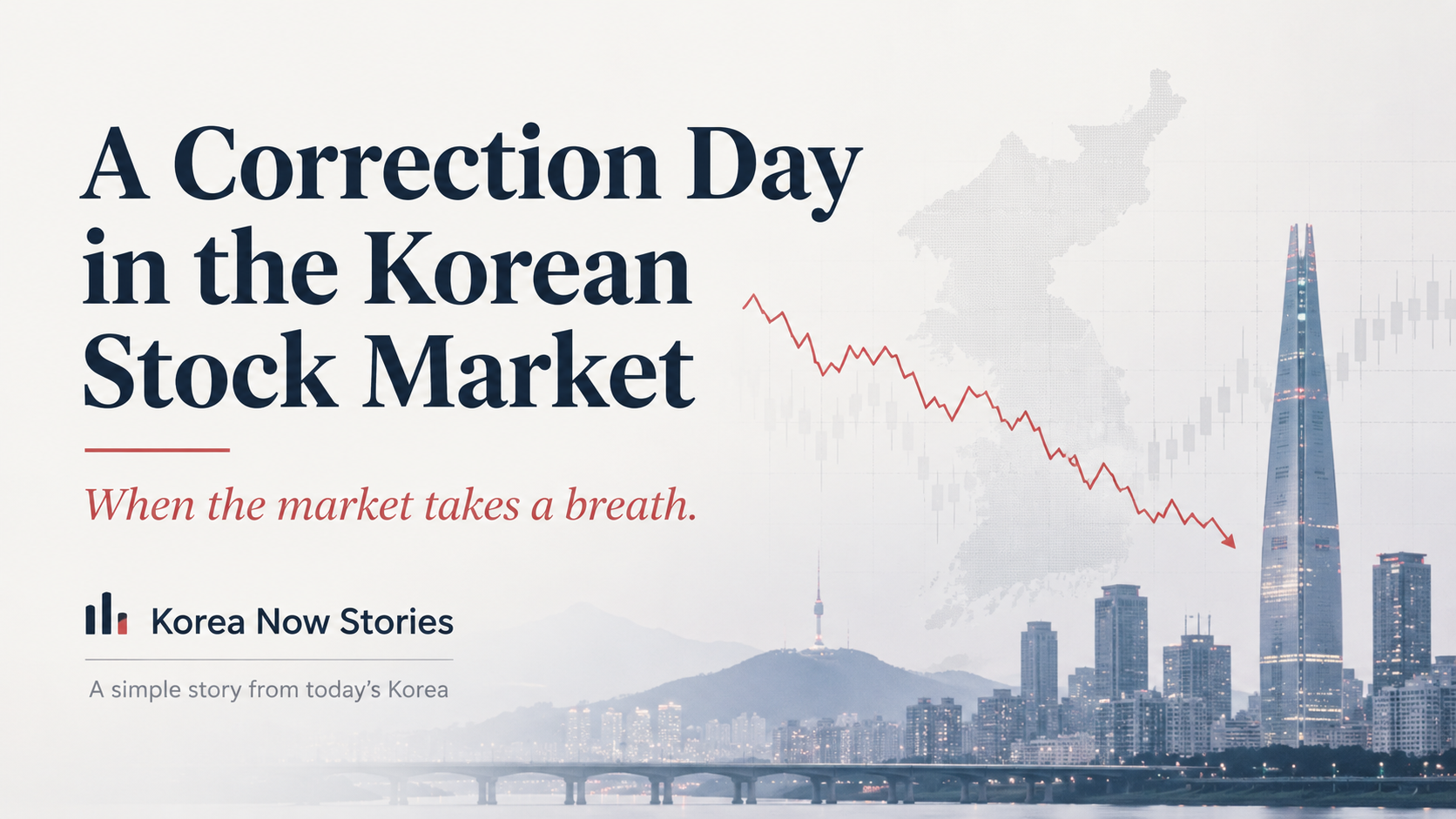
    A Correction Day in the Korean Stock Market

    Today was a correction day in the Korean stock market.

    For many people, a correction simply means that stock prices went down. But in Korea, a market correction often feels like more than numbers on a screen. It becomes a small emotional weather report for investors, office workers, business owners, and ordinary people checking their phones between daily routines.

    In the morning, the mood can change very quickly. Some investors open their trading apps expecting another strong day, only to see red numbers spreading across the screen. Popular stocks that looked powerful yesterday may suddenly lose momentum. Semiconductor names, battery stocks, shipbuilding companies, tech-related shares, and smaller momentum stocks can all move differently, but the feeling is often similar: the market is taking a breath.

    In Korean stock communities, people often use the word “조정장” — pronounced jo-jeong-jang. It means a correction market.

    A correction does not always mean a crash. Sometimes it simply means the market is cooling down after moving too fast. In a fast-moving market, this can feel uncomfortable. But it can also reveal something important: which stocks are truly strong, and which ones were only moving with the crowd.

    What makes the Korean market interesting is the emotional speed. Prices move quickly. Comments move quickly. Fear and hope also move quickly.

    One moment, people say, “This stock will keep going up.”
    A few hours later, they ask, “Should I sell now?”

    This is one of the reasons the Korean stock market feels so alive. It is not only about companies and charts. It is also about timing, crowd psychology, news, liquidity, and the daily rhythm of people trying to make better decisions.

    For long-term investors, a correction day can be a chance to look again at strong companies. For short-term traders, it can be a warning to slow down and protect cash. For beginners, it can be a lesson: the market does not move in a straight line.

    Today’s Korean market reminded us of something simple.

    Even when a market looks strong, it needs moments to pause.

    And sometimes, that pause tells a better story than the rise itself.

    This post is for informational and cultural purposes only. It is not financial advice.
  • Hello world!

    Welcome to WordPress. This is your first post. Edit or delete it, then start writing!